

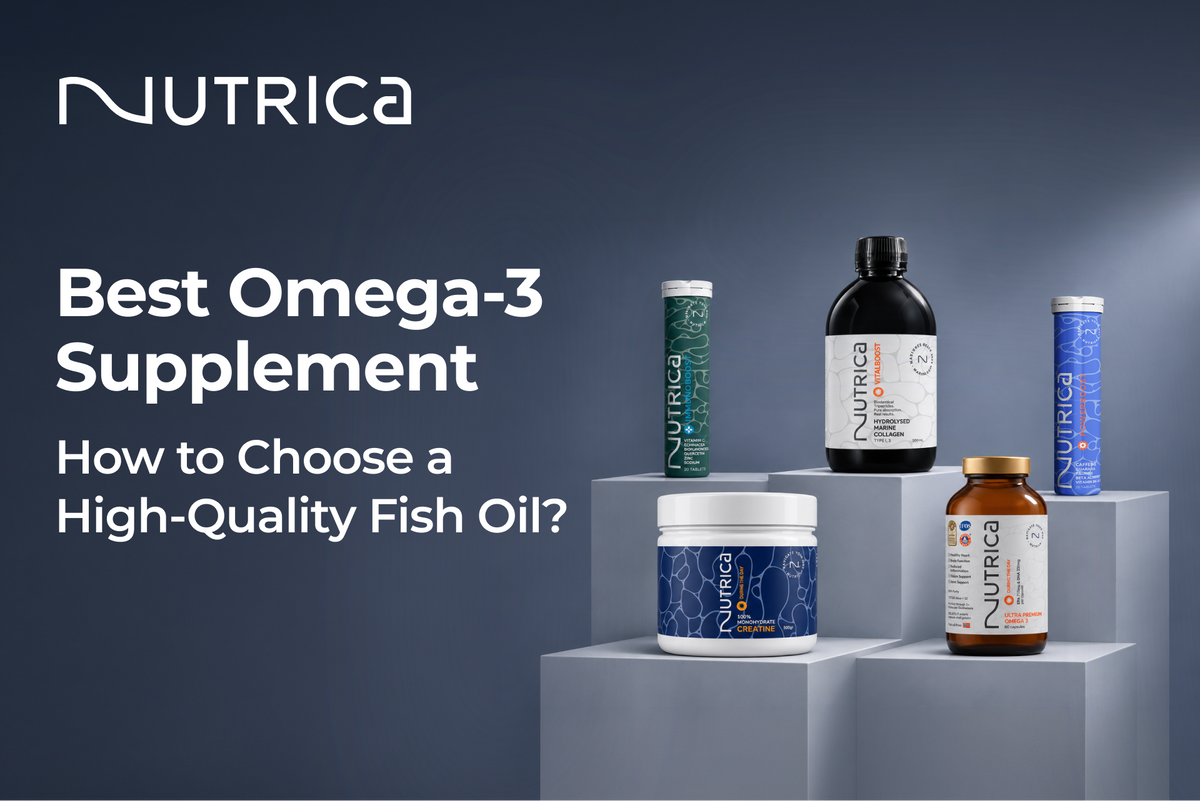
The best omega-3 supplement is the one that gives you a high, clearly stated dose of EPA and DHA per capsule, in fresh, independently tested oil. "Premium" on a label means nothing on its own. This guide walks you through the seven checks, numbers and certificates that actually tell good fish oil from bad.
What is Omega-3?
Omega-3s are a family of essential polyunsaturated fatty acids that the body needs to function properly but cannot produce on its own, so they must come from diet or supplements.
There are three major types of omega-3:
- EPA (eicosapentaenoic acid): a long-chain marine omega-3 fatty acid, found mainly in oily cold-water fish such as salmon, mackerel and sardines.
- DHA (docosahexaenoic acid): another long-chain marine omega-3 fatty acid, found mainly in fatty fish and seafood. It is a key structural component of the brain and retina.
- ALA (alpha-linolenic acid): a plant-based omega-3 found in flaxseed, chia seeds, walnuts and plant oils such as soybean oil. Your body uses it for energy and can convert a small amount into EPA and DHA.
Because the conversion of ALA into EPA and DHA is limited, people who rarely eat oily fish often look to a supplement that provides EPA and DHA directly.
What are the Major Omega-3 Benefits?
Omega-3 fatty acids EPA and DHA are associated with several recognised health benefits. The European Union authorises specific fish oil benefits, subject to conditions of use:
- Heart function: EPA and DHA contribute to the normal function of the heart. The beneficial effect is obtained with a daily intake of 250 mg of EPA and DHA.
- Brain function: DHA contributes to maintenance of normal brain function. The beneficial effect is obtained with a daily intake of 250 mg of DHA.
- Vision: DHA contributes to the maintenance of normal vision. The beneficial effect is obtained with a daily intake of 250 mg of DHA.
One capsule of Nutrica Ultra Premium Omega-3 provides at least 1,040 mg of EPA and DHA combined, including at least 325 mg of DHA. These amounts meet the intake conditions for all three health claims.
Why EPA and DHA per Capsule Matter Most
EPA and DHA are the active omega-3 fatty acids behind the health benefits. The most common trick in omega-3 labelling is to highlight the amount of fish oil instead of the amount of EPA and DHA. A "1,000 mg fish oil" capsule may contain only 300 mg of EPA and DHA; the rest is other fats. That is why, when looking for the best fish oil supplement, you should always check the EPA and DHA content, not just the total fish oil amount.
Nutrica Ultra Premium Omega-3 states its EPA and DHA per capsule and publishes independent test results for each tested batch:
| Per capsule | Label minimum | Latest IFOS-tested batch (11225.1) |
|---|---|---|
| EPA | 715 mg | 733 mg |
| DHA | 325 mg | 348 mg |
| EPA + DHA | 1,040 mg | 1,081 mg |
| Total omega-3 | 1,105 mg | 1,200 mg |
For complete transparency, you can review the Nutrica Ultra Premium Omega-3 IFOS Certificate to verify the batch-specific test results.
Results vary slightly between batches; the label minimum is what every batch must meet.
rTG vs Ethyl Ester: Does the Form of Fish Oil Matter?
Fish oil comes in three main forms:
- Natural triglyceride (TG): the form that occurs naturally in fish, usually containing around 30% EPA and DHA.
- Ethyl ester (EE): produced by attaching fatty acids to ethanol. This form is commonly used to concentrate EPA and DHA in fish oil supplements.
- Re-esterified triglyceride (rTG): concentrated fish oil converted back into triglyceride form, giving a high dose in the natural structure.
You'll also see krill oil, which provides EPA and DHA mainly as phospholipids, along with choline and the antioxidant pigment astaxanthin. Its EPA and DHA content varies by product and is often lower per capsule than that of concentrated fish oil.
The form of fish oil can affect absorption, particularly when taken with a low-fat meal. In a classic study, EPA absorption from triglyceride oil was reported at 68% of that from free fatty acids, compared with 20% for ethyl esters. These figures reflect the conditions of that particular study rather than universal absorption rates. Other research has found that taking ethyl ester fish oil with dietary fat can improve its absorption, so taking omega-3 supplements with a meal is a practical approach.
Nutrica Ultra Premium Omega-3 uses VivoMega™ 5525 TG, a concentrated triglyceride oil with at least 55% EPA and 25% DHA. Concentrates at this strength are re-esterified triglycerides (rTG).
Freshness: Why Oxidation Testing Matters
EPA and DHA are delicate fats that react with oxygen, heat and light. Oxidised (rancid) fish oil tastes and smells fishy, and quality bodies set strict limits on it. Three measurements tell you how fresh an oil is:
- Peroxide value (PV): measures primary oxidation products formed during the early stages of oxidation.
- Anisidine value (AV): measures secondary oxidation products that form as oxidation progresses.
- TOTOX: gives an overall measure of oxidation by combining both values, using the formula 2 × PV + AV.
In general, lower oxidation values indicate less oxidised oil, although these measurements should be considered together to judge the oxidative quality of an omega-3 supplement.
| Measure | GOED industry limit | IFOS limit | Nutrica batch 11225.1 |
|---|---|---|---|
| Peroxide value (meq/kg) | ≤ 5 | ≤ 5 | 0.15 |
| Anisidine value | ≤ 20 | ≤ 20 | 6.36 |
| TOTOX | ≤ 26 | ≤ 19.5 | 6.66 |
| Acid value (mg KOH/g) | ≤ 3 | ≤ 3 | 0.19 |
Purity: Heavy Metals and Pollutants
Ocean pollutants such as mercury, lead, PCBs and dioxins can build up in fish. High-quality fish oil is refined to reduce these contaminants and tested to confirm that it meets applicable quality standards. Small fish lower in the food chain, such as anchovy, sardine and mackerel, generally accumulate fewer contaminants than large predatory fish.
| Contaminant | IFOS limit | Nutrica batch 11225.1 |
|---|---|---|
| Mercury | ≤ 0.1 mg/kg | < 0.0124 mg/kg (below detection) |
| Lead | ≤ 0.05 mg/kg | < 0.0066 mg/kg (below detection) |
| Cadmium | ≤ 0.1 mg/kg | < 0.0017 mg/kg (below detection) |
| Total arsenic | ≤ 0.1 mg/kg | < 0.0066 mg/kg (below detection) |
| Total PCBs | ≤ 45 ppb | 0.205 ppb |
| Dioxins and furans | ≤ 1 ppt WHO-TEQ | 0.197 ppt WHO-TEQ |
| Dioxin-like PCBs | ≤ 1.5 ppt WHO-TEQ | 0.0161 ppt WHO-TEQ |
For Nutrica batch 11225.1, the reported results for mercury, lead, cadmium and total arsenic were below the laboratory's stated reporting thresholds. The results for PCBs, dioxins and furans, and dioxin-like PCBs were also well below the limits listed in the table.
IFOS, Informed Sport and Friend of the Sea: Why Each Certificate Matters
These three certifications assess different aspects of a product: quality, sports safety and sourcing. One cannot substitute for another.
| Certificate | What it checks | Why it matters |
|---|---|---|
| IFOS (International Fish Oil Standards) | Omega-3 content, oxidation and contaminants against applicable testing standards | Provides batch-specific information about potency, freshness and purity |
| Informed Sport | Every batch tested for substances prohibited in sport | Helps athletes reduce the risk of taking supplements contaminated with prohibited substances |
| Friend of the Sea | Sourcing assessed against applicable sustainability and fisheries standards | Provides assurance about the sustainability of the certified source |
Nutrica Ultra Premium Omega-3 holds all three. It is made with VivoMega™ oil sourced from anchovy, sardine and mackerel. Athletes can also read our guide to choosing supplements tested for prohibited substances to understand how sports supplement testing works.
How Much Omega-3 per Day is Recommended?
For healthy adults, the European Food Safety Authority (EFSA) sets an adequate intake of 250 mg of EPA and DHA per day, roughly what one or two portions of oily fish a week provide. One Nutrica omega-3 capsule provides at least 1,040 mg of EPA and DHA combined, but whether one capsule a day is right for you depends on your diet and the product's recommended daily dose. Always follow the dose on the label and do not exceed it.
EFSA has also concluded that supplemental intakes of up to 5 g of EPA and DHA combined per day do not raise safety concerns for adults. That is an upper safety level, not a target.
When to take it: Take it with a meal that contains some fat, which can help absorption and may reduce fishy aftertaste. Morning or evening makes no difference; consistency does.
How to store it: Store in a cool, dry, dark place with the lid closed, and follow the storage instructions on the label.
Omega-3 for Athletes
Many athletes don't eat oily fish regularly. In a study of NCAA Division I American football players, Anzalone and colleagues found that all participants had Omega-3 Index values below 8%. The Omega-3 Index measures EPA and DHA as a percentage of the fatty acids in your red blood cells. Researchers generally regard 8–12% as the desirable range and below 4% as low; the target comes from cardiovascular research. Reaching 8% typically takes roughly 1–1.5 g of EPA and DHA a day over several months, depending on your starting level. A simple finger-prick test can show where you stand before you decide whether to supplement.
Researchers are also studying omega-3 in relation to muscle soreness and recovery. Results so far are mixed and the effects modest, and the evidence does not establish omega-3 supplementation as a guaranteed way to improve athletic recovery. Energy, protein, carbohydrate, hydration and sleep remain the foundations of recovery. Sports studies have commonly used around 2 g of EPA and DHA per day, but that is a research protocol, not a recommendation; follow your product's label or seek guidance from a sports dietitian.
Who Should Check with a Doctor First?
- People on blood-thinning medication (anticoagulants or antiplatelets): omega-3 may affect platelet function, especially at higher doses.
- People with a fish or seafood allergy: most omega-3 supplements contain fish. Check the allergen information.
- People with heart rhythm problems or heart disease: research on omega-3 supplementation and atrial fibrillation (an irregular heart rhythm) suggests that the risk may depend on the dose and a person's cardiovascular risk. A 2021 meta-analysis by Gencer and colleagues found a higher risk, particularly in studies using doses above 1 g per day. The STRENGTH trial, which used 4 g per day in high-risk patients, also reported more cases of atrial fibrillation, while the VITAL trial, which used 840 mg per day in approximately 25,900 adults, found no clear increase. Observational studies have reported mixed findings, so anyone with atrial fibrillation or heart disease should consult their doctor before taking omega-3 supplements.
- Pregnant or breastfeeding women, and anyone taking regular medication.
Fish Oil vs Vegan Omega-3
Fish get their EPA and DHA from the algae they eat. Algae oil supplements go straight to the source, making them the main vegan option. Most vegan omega-3 supplements are rich in DHA, and some also provide EPA. In one study, algal oil capsules raised blood DHA as effectively as eating cooked salmon.
Nutrica doesn't currently offer an algae-based omega-3. If you are vegan, look for algae oil with stated EPA and DHA amounts and the same freshness and purity testing described above.
How to Choose the Best Omega-3 Supplement: 7 Checks
Here is a simple checklist to follow when looking for the best omega-3 supplement:
- EPA + DHA per capsule: Check the actual amounts of EPA and DHA, not just the total fish oil content. Higher concentrations can mean fewer capsules are needed to obtain a given amount.
- Form: Check whether the oil is in re-esterified triglyceride (rTG), natural triglyceride (TG) or ethyl ester (EE) form. Ethyl esters may be less efficiently absorbed with low-fat meals, so meal composition matters.
- Freshness: Look for published oxidation test results, including the TOTOX value. A value below the IFOS limit of 19.5 meets that benchmark, and lower values generally indicate less oxidation.
- Purity: Check the published test results for contaminants such as mercury, lead, PCBs and dioxins.
- Independent testing and certification: The best omega-3 supplement brands should have independent IFOS testing for fish oil quality. Athletes subject to anti-doping controls should also look for Informed Sport certification.
- Sourcing and sustainability: Check the fish species used and look for a recognised sustainability certification, such as Friend of the Sea.
- Country of production: Check where the oil is produced and processed. Norwegian production, for example, can be a useful sourcing detail, but country of origin alone does not guarantee quality.
Also check the allergen information and what the capsule shell is made of.
Nutrica Ultra Premium Omega-3
Nutrica Ultra Premium Omega-3 combines concentrated EPA and DHA with batch testing, quality controls and certified sourcing.
- High EPA and DHA content: Each capsule provides at least 715 mg of EPA and 325 mg of DHA from 1,300 mg of concentrated fish oil, with at least 1,105 mg of total omega-3.
- Concentrated triglyceride oil: Uses VivoMega™ 5525 TG concentrate in triglyceride form, sourced from anchovy, sardine and mackerel.
- Antioxidant ingredients: Contains 1 mg of natural astaxanthin (AstaPure®, from the microalga Haematococcus pluvialis), along with natural tocopherols and rosemary extract to help protect the oil against oxidation.
- Enteric-coated softgel: Uses DELASOL™ technology, designed to release the oil further along the digestive tract and help reduce fishy aftertaste.
- Batch-tested freshness: The latest tested batch recorded a TOTOX value of 6.66, well below the IFOS 5-star benchmark of 19.5.
- IFOS certified: The product has passed IFOS purity and potency testing. You can review the Nutrica Ultra Premium Omega-3 IFOS test report for batch-specific results.
- Informed Sport certified: The product is part of the Informed Sport programme, which tests every certified batch for substances prohibited in sport.
- Sustainability verification: Its VivoMega™ oil is Friend of the Sea verified.
- EU manufacturing: Manufactured in Spain by an IFS Food-certified manufacturer.
- Allergen and capsule information: Contains fish and uses a bovine gelatin capsule, so it is not suitable for vegetarians.
EPA and DHA contribute to the normal function of the heart. The beneficial effect is obtained with a daily intake of 250 mg of EPA and DHA.
The Bottom Line
Ignore the word "premium" and check the numbers: EPA and DHA per capsule, oil form, freshness, purity and independent certification. A good omega-3 publishes all of them. Take it daily with a meal, at the label dose, and speak to your doctor first if you take blood thinners or have a heart rhythm condition.
Food supplements should not be used as a substitute for a varied and balanced diet and a healthy lifestyle. Do not exceed the recommended daily dose. Keep out of reach of young children.
Frequently Asked Questions
What is the best omega-3 supplement?
Look for a supplement with clearly stated amounts of EPA and DHA per capsule, published freshness and purity results, and independent testing or certification, such as IFOS. The oil form is another factor to consider.
How much omega-3 should I take per day?
EFSA's adequate intake for adults is 250 mg of EPA and DHA combined per day. Follow your supplement's recommended daily dose and do not exceed it.
What are the benefits of omega-3?
EPA and DHA contribute to the normal function of the heart at a combined daily intake of 250 mg. DHA contributes to the maintenance of normal brain function and normal vision at a daily intake of 250 mg of DHA for each claim.
What is the difference between rTG and ethyl ester fish oil?
Re-esterified triglyceride (rTG) oil is concentrated fish oil converted back into triglyceride form. Ethyl ester (EE) oil is another concentrated form, and its absorption can be more sensitive to the fat content of a meal.
What is TOTOX in fish oil?
TOTOX is a measure of overall oil oxidation, calculated as 2 × peroxide value (PV) + anisidine value (AV). Lower values generally indicate less oxidation. The IFOS benchmark cited in this article is 19.5.
When is the best time to take omega-3?
Take omega-3 with a meal containing some fat to help absorption. The time of day matters less than taking it consistently, as directed on the label.
How much EPA and DHA is in Nutrica Ultra Premium Omega-3?
Each capsule provides at least 715 mg of EPA and 325 mg of DHA, totalling 1,040 mg, from 1,300 mg of fish oil. The latest IFOS-tested batch contained 733 mg of EPA and 348 mg of DHA.
Is Nutrica Ultra Premium Omega-3 Informed Sport certified?
Yes. Nutrica Ultra Premium Omega-3 is Informed Sport certified, with every batch tested for substances prohibited in sport. You can confirm its status on the Informed Sport website.
Can omega-3 supplements cause side effects?
Possible side effects include fishy aftertaste and mild digestive discomfort; taking omega-3 with food may help. Nutrica's enteric softgel is designed to delay the release of the oil, which may help reduce fishy aftertaste. People taking blood-thinning medication or those with heart rhythm problems should consult their doctor before use.
Can vegans take omega-3?
Yes. Algae oil is a plant-based source of omega-3 that provides DHA, and some formulations also provide EPA. Nutrica does not currently offer an algae-based omega-3 supplement.
References
- Commission Regulation (EU) No 432/2012 establishing a list of permitted health claims (EPA and DHA: heart; DHA: brain and vision).
- EFSA NDA Panel. Scientific Opinion on Dietary Reference Values for fats. EFSA Journal. 2010;8(3):1461.
- EFSA NDA Panel. Scientific Opinion on the Tolerable Upper Intake Level of EPA, DHA and DPA. EFSA Journal. 2012;10(7):2815.
- Lawson LD, Hughes BG. Human absorption of fish oil fatty acids as triacylglycerols, free acids, or ethyl esters. Biochem Biophys Res Commun. 1988;152(1):328–335.
- Dyerberg J, et al. Bioavailability of marine n-3 fatty acid formulations. Prostaglandins Leukot Essent Fatty Acids. 2010;83(3):137–141.
- Nordøy A, et al. Absorption of the n-3 eicosapentaenoic and docosahexaenoic acids as ethyl esters and triglycerides by humans. Am J Clin Nutr. 1991;53(5):1185–1190.
- Anzalone A, et al. The Omega-3 Index in National Collegiate Athletic Association Division I Collegiate Football Athletes. J Athl Train. 2019;54(1):7–11.
- Harris WS, von Schacky C. The Omega-3 Index: a new risk factor for death from coronary heart disease? Prev Med. 2004;39(1):212–220.
- Gencer B, et al. Effect of long-term marine omega-3 fatty acids supplementation on the risk of atrial fibrillation in randomized controlled trials of cardiovascular outcomes: a systematic review and meta-analysis. Circulation. 2021;144(25):1981–1990.
- Thielecke F, Blannin A. Omega-3 fatty acids for sport performance: are they equally beneficial for athletes and amateurs? A narrative review. Nutrients. 2020;12(12):3712.
- GOED. Voluntary Monograph for omega-3 oils (oxidation limits).
- IFOS / SGS Nutrasource. Nutrica Ultra Premium Omega-3, batch 11225.1. IFOS certificate (PDF).
- Walker RE, et al. Predicting the effects of supplemental EPA and DHA on the omega-3 index. Am J Clin Nutr. 2019;110(4):1034–1040.
- Manson JE, et al. Marine n-3 fatty acids and prevention of cardiovascular disease and cancer (VITAL). N Engl J Med. 2019;380(1):23–32.
- Nicholls SJ, et al. Effect of high-dose omega-3 fatty acids vs corn oil on major adverse cardiovascular events in patients at high cardiovascular risk: the STRENGTH randomized clinical trial. JAMA. 2020;324(22):2268–2280.
- Chen G, et al. Regular use of fish oil supplements and course of cardiovascular diseases: prospective cohort study. BMJ Medicine. 2024;3(1):e000451.
- Arterburn LM, et al. Algal-oil capsules and cooked salmon: nutritionally equivalent sources of docosahexaenoic acid. J Am Diet Assoc. 2008;108(7):1204–1209.


